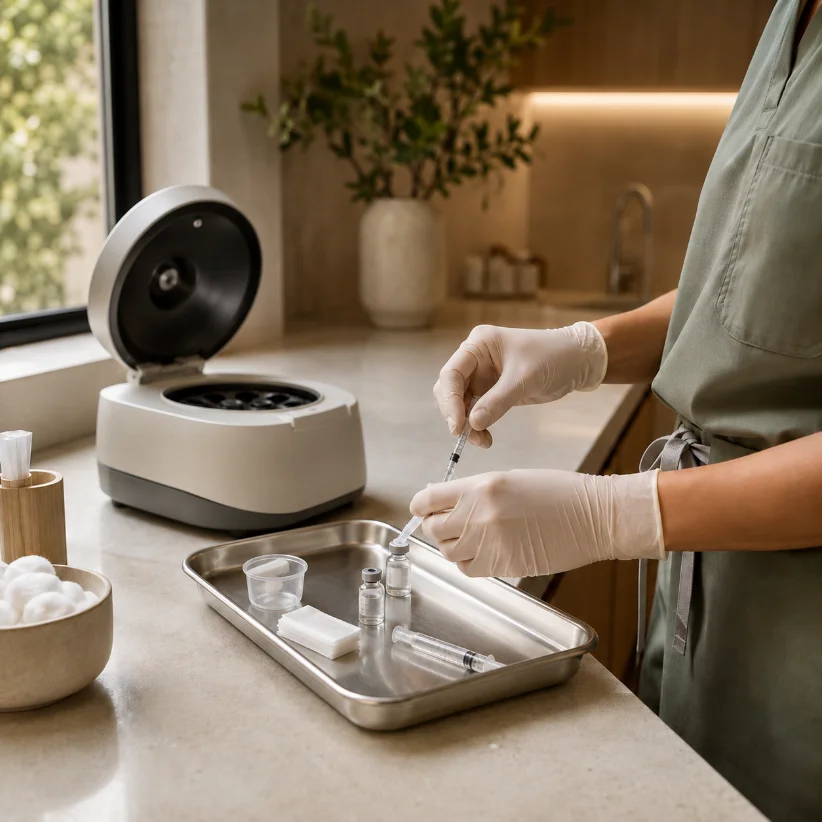
The information on this page is general and educational and is not medical advice. PRP and other regenerative treatments are not appropriate for every patient, and results vary from person to person. Whether a treatment is appropriate — along with its risks, benefits, and expected outcomes — depends on the individual patient and is determined by the treating healthcare provider, who retains sole responsibility and authority for clinical decisions and patient care.
What Makes This PRP Different
Platelet-rich plasma takes a different approach to musculoskeletal injury than surgery or steroid injections — it is intended to work with the body's own healing response rather than override it.
Regenerative, not palliative
Steroid injections reduce inflammation and mask pain, and repeated use can weaken cartilage, tendons, and ligaments over time. PRP concentrates a patient's own platelets and growth factors and reintroduces them directly into the injured area to stimulate the body's natural repair process at the cellular level. It is intended to support the body's natural repair response rather than solely address symptoms.
Autologous
Because it's derived from the patient's own blood, no foreign material is introduced and immune rejection is not a concern. As with any injection, side effects are possible and should be discussed with the treating provider.
Non-surgical and in-office
For many soft-tissue and joint injuries, PRP is a non-surgical option — no incisions and no general anesthesia. It's performed in-office in under an hour, and recovery time varies from patient to patient. Whether PRP is appropriate in place of surgery is a determination for the treating physician.
Precision-driven
Ultrasound guidance places the injection exactly at the site of injury rather than relying on surface landmarks — which matters both for clinical outcomes and for the accuracy of the documentation behind them.
One Consistent Protocol
Every case follows the same standardized preparation and technique. That consistency is the point: consistent inputs are what make outcomes — and the records behind them — consistent. It's the opposite of a bedside kit and a technique that changes with whoever happens to be in the room.
A protocol built around one defined preparation, ultrasound-guided delivery, and validated outcome measures produces records that are more accurate and more acceptable — to payers, to referring physicians, and to a practice tracking its own results.
What It Offers the Patient
What It Offers the Practice
On Outcomes
Regenitiva has a formal outcomes study in progress, and we don't market unverified statistics as claims. What a standardized protocol makes possible is measurement: because every case is delivered the same way, your program's results can be tracked against validated measures rather than anecdotes. See Outcome Tracking & Data Analytics for how we build that into a practice.
Bringing the Protocol Into Your Practice
The protocol is delivered as part of a full program build — the clinical model, in-person training to competency, and the compliance documentation around it. Your whole team is trained on-site by board-certified physicians in pain medicine and musculoskeletal ultrasound, with the first cases proctored live.
See Regenerative Medicine Practice Development for the full build, or Clinical Program Implementation for putting the protocol and workflows in place.
Getting Started
The first step is an introductory conversation — a short call with our CEO, Vince Surra, to talk through whether a practice assessment makes sense for you.
Reach out through the contact form and we'll be in touch within one business day, usually sooner, or book a call directly.